How AI Image to 3D Workflow Speeds Up Background Asset Creation in Modern Production
In many 3D production pipelines, artists constantly face the same challenge: how to create unique assets quickly without draining time or budget. When a project requires elements that cannot be purchased, scanned, or easily modeled by hand, the cost of building each asset becomes a real concern. The hybrid AI image to 3D workflow offers a practical, time saving solution. It gives artists fast access to usable background models without the long hours normally required to create them. This blog explores how the process works, why it matters, and how it is reshaping modern production practices.
The Production Problem: When Custom Models Become a Bottleneck
Skilled modelers and animators can technically create any object a scene requires.
The real question is whether each asset deserves several hours of labor.
This is especially challenging for:
-
Background objects
-
Set dressing
-
Props that support, but do not define, the story
-
Elements the camera barely examines
Traditional workflows force artists to balance quality with time. They must produce assets that are good enough without overwhelming the project budget. When dozens or even hundreds of background models are required, this balancing act becomes a major production hurdle.
How an AI hybrid Rendering Workflow Solves the Problem
Modern AI image to 3D converters can take a single photograph and produce a rough but usable 3D model. This replaces hours of manual modeling or on site scanning with a near instant solution.
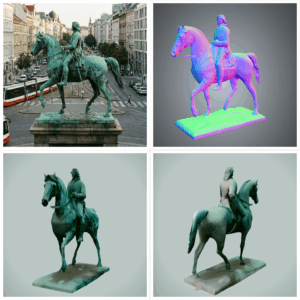
For example, an image of a public equestrian statue can be uploaded to an AI tool. The system automatically reconstructs a 3D approximation of the object. This eliminates several challenges:
-
Manual sculpting is time consuming
-
Photogrammetry requires physical access to the object
-
Stock marketplaces may not offer anything similar
While the generated model may not achieve hero level accuracy, it is often ideal for background placement. From a distance, the asset reads correctly, maintains the intended silhouette, and fills the necessary space within the scene.
Creating such an element in 10 to 15 minutes instead of several hours allows artists to redirect their energy to the work that truly matters, such as hero props, lighting, story driven animation, or core design tasks.
AI Tools Supporting Image Based 3D Generation
Several AI platforms now offer single image or multi image 3D reconstruction. Popular options include:
Each platform differs in its strengths, output quality, and workflow integration, but they all deliver the same essential benefit: fast, cost efficient prototyping that accelerates production and reduces bottlenecks.
Why an AI hybrid Rendering Workflow Matters for Background Assets
This workflow excels in scenarios where:
-
The model will not be examined up close
-
The object is needed quickly
-
No stock asset is available
-
Photogrammetry is not possible
-
Custom work would consume too much time
Instead of perfect fidelity, the goal is practical accuracy. The model looks believable in context, serves its narrative purpose, and keeps the project moving forward.
By adopting AI image to 3D workflow methods, studios can significantly expand their production capacity without adding overhead. It gives artists more freedom to focus on high value tasks and creative decision making.
The Future of Fast Asset Creation
As AI reconstruction continues to advance, these tools will only grow more reliable and more accurate. For projects with tight timelines or limited budgets, AI image to 3D workflow systems are already proving essential. They enhance efficiency, reduce manual labor, and provide a smart way to generate background assets that support the larger creative vision.
AI is not replacing traditional modeling. It is simply giving artists another tool to work smarter and faster.
Do you have a project in mind? Send us a message and let’s chat!
Phone: 816-525-0103
Email: sales@trinityanimation.com